A damaged tooth or a gap does not automatically point to one replacement method. You need to match the restoration to the remaining tooth structure, supporting tissues, number and position of missing teeth, health risks, budget, and the amount of treatment you can maintain. By the end, you can identify which findings support fixed or removable prosthodontic therapy and which problems must be treated first.
Key takeaways
- Choose fixed treatment when stability, chewing and a permanent feel are priorities.
- Choose removable treatment when affordability, simpler replacement or multiple missing teeth matter.
- Check bone, gum health, supporting teeth, bite and cleaning ability before treatment.
- Ask how each option affects maintenance, appointments, comfort and future repairs.
What fixed and removable prosthodontic therapy actually means
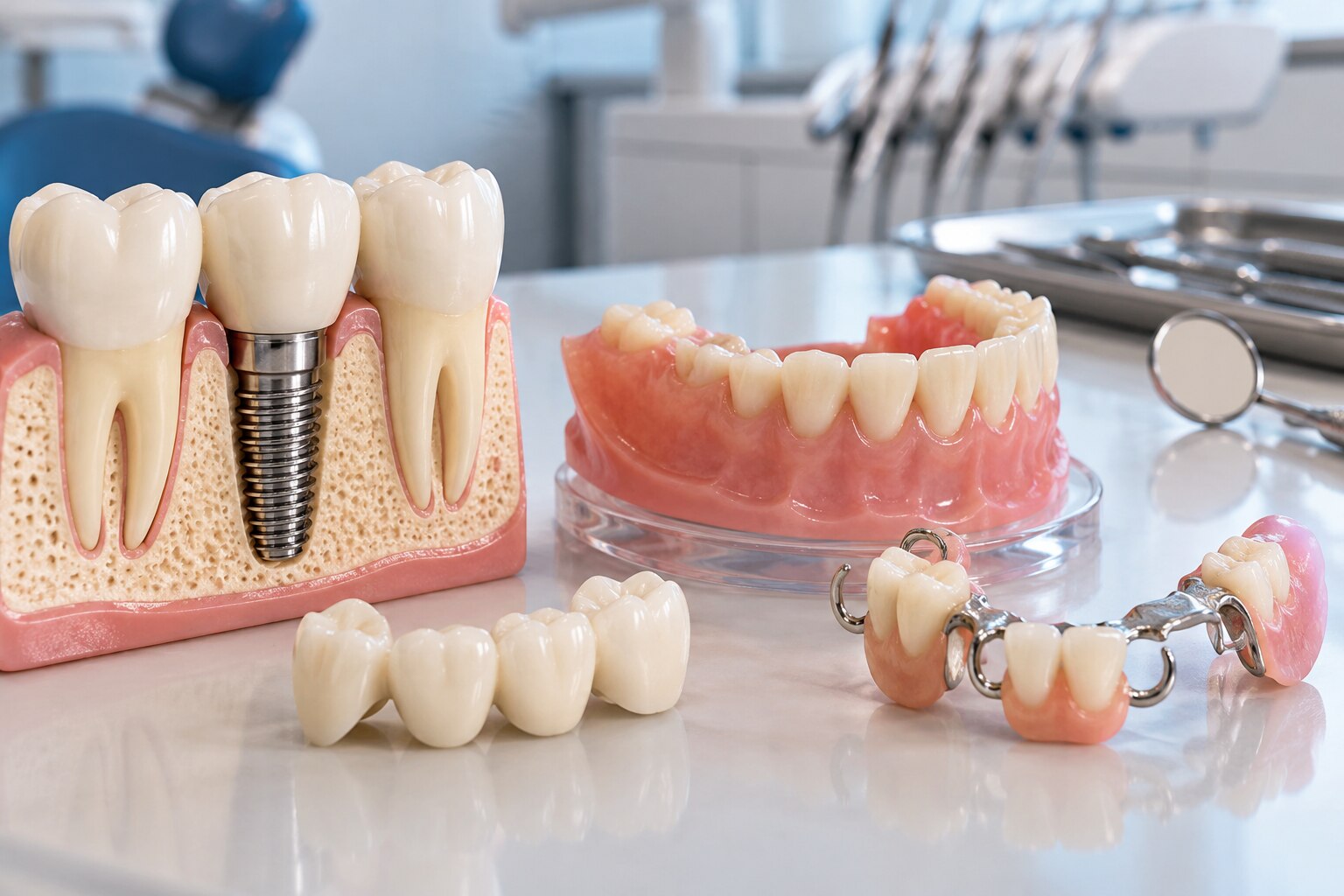
Fixed prosthodontics means replacing or covering damaged or missing teeth with restorations that remain in place during eating, speaking and cleaning. It includes crowns, conventional bridges, and implant-supported crowns or bridges. Removable prosthodontics uses a prosthesis that you take out, usually for cleaning and sometimes overnight.
Fixed restorations are retained in two main ways:
| Type | How it is retained | How you use it |
|---|---|---|
| Fixed tooth-supported | Cemented restorations attach to prepared natural teeth | You do not remove them at home |
| Fixed implant-supported | Screwed-in restorations attach to dental implants, or restorations are cemented onto implant components | You use them like fixed teeth; a dentist removes them for repair or replacement |
| Removable partial or complete | A framework, clasps, suction, or denture-bearing tissues hold the prosthesis in place | You remove it for cleaning and rest |
| Implant-retained overdenture | Attachments on implants improve retention while the denture remains removable | You remove it to clean the denture and the attachments |
A complete denture replaces the visible crowns of all teeth in one arch but does not reproduce their roots. A removable partial denture can replace several teeth in different areas when a bridge is impractical; its rests, framework and clasping need careful planning around the remaining teeth.
Flexible dentures use a flexible base and clasps, while overdentures fit over remaining roots or implants. None is maintenance-free: brush your natural teeth, clean the prosthesis outside your mouth, and attend examinations.
When a fixed restoration is the more suitable choice
A crown suits one damaged tooth when enough sound tooth structure remains to retain it and the surrounding gum and bone provide stable support. An unrestorable fracture, decay extending below the gum, or an infection that cannot be treated makes extraction and replacement safer than crowning.
| Fixed option | Tooth or gap condition that supports it | Main limitation |
|---|---|---|
| Crowns | One structurally weakened tooth with a restorable root, adequate remaining walls and healthy periodontal support | Requires enough tooth structure for retention |
| Conventional bridges | A short gap with a strong, stable tooth on one or both sides; proposed abutments have manageable decay, no active periodontal disease, suitable roots and enough crown-to-root support | Sound abutment teeth must be reduced and carry extra chewing load |
| Implant-supported crowns | One missing tooth with adequate implant support in the jaw and neighbouring teeth that you want to leave untouched | Requires surgery, healing and long-term implant maintenance |
| Implant-supported bridges | Several adjacent missing teeth where implants can support the span and the bone can accommodate them | Involves surgery, healing and possible implant complications |
Conventional bridges are more predictable when the supporting teeth are firm, cleanable and strong enough for the added leverage. An implant-supported crown or implant-supported bridge is attractive when adjacent teeth are healthy, because it avoids preparing them; the trade-off is surgical treatment and implant-specific maintenance.
Fixed treatment becomes less suitable when the gap is extensive, too few reliable abutments remain, or bone support cannot safely support implants.
When removable treatment is more practical
Removable treatment makes more sense when the number, position, or condition of missing teeth makes fixed support unreliable, invasive, or unnecessarily costly. It also suits patients who need a non-surgical replacement while teeth, gums, bone, or general health are being treated.
- Several teeth are missing across different parts of the arch.
- The gap is too extensive for the available abutment teeth to support a bridge.
- Remaining teeth have inadequate periodontal support, or implant placement is limited by bone, medical factors, cost, or treatment time.
- You need an interim replacement that can be removed for repair, adjustment, or cleaning.
Complete dentures replace the visible crowns of every tooth in one arch. They restore appearance and some chewing ability, but they do not replace roots, and their retention and chewing efficiency are lower than those of natural teeth or well-supported fixed restorations.
Removable partial dentures can replace multiple teeth with a planned framework, rests, and clasps or other retainers. They are not simply temporary bridges; poor design or cleaning can increase plaque around the remaining teeth.
Flexible dentures may appeal when visible metal clasps are a concern, but their flexibility can reduce support and make repair or adjustment more difficult.
Implant-supported overdentures make sense when you want better retention than a conventional lower denture provides and can undergo implant surgery. They still come out for cleaning, require care around the attachments, and need periodic maintenance as components wear.
What you trade off between fixed and removable options
A fixed prosthesis usually feels more like part of your teeth, while a removable one gives you easier access and fewer irreversible changes. The choice involves more than appearance.
| Dimension | Fixed prosthesis | Removable prosthesis |
|---|---|---|
| Stability | Cemented or screwed restorations do not move during normal use. | Dentures can shift; implant-supported overdentures improve stability but still come out. |
| Chewing efficiency | Usually higher, especially with sound abutments or well-integrated implants. | Restores useful chewing, but complete dentures generally provide less chewing efficiency. |
| Speech | Usually requires little adaptation. | Speech can change until your tongue adapts to the denture’s shape and movement. |
| Appearance and esthetics | Can closely match tooth colour, contour and gum display. | Can replace visible teeth and support the lips, but clasp visibility or movement can affect appearance. |
| Hygiene | Clean under bridges and around implant components with specialised brushes or floss. | Remove and clean the prosthesis outside the mouth; brush remaining teeth and tissues. |
| Treatment time | A conventional bridge may be quicker; implants require surgery and healing. | Often provides a faster replacement, especially when surgery is unsuitable. |
| Maintenance | Requires examinations, cleaning and possible repair or replacement. | Requires adjustment, relining, attachment servicing and replacement of worn parts. |
| Reversibility | Tooth preparation or implant surgery cannot simply be undone. | Usually more reversible, though clasping can overload or plaque-trap supporting teeth. |
| Longevity | Depends on tooth support, implant health, loading and maintenance. | Dentures and attachments wear, requiring periodic repair or replacement. |
At Sri Krishna Multispecialty Dental & Implant Studio, ask which trade-off applies to your bite, remaining teeth, bone support and cleaning ability—not only which option looks best.
Related services
Crowns & Bridges Precision-Fit Restorations for Damaged or Missing Teeth – Designed Digitally for Function and Esthetics Crowns and bridges are fixed dental... View service → |
Crowns & Bridges Rebuilding Smiles, Restoring Confidence and Function – Digitally and Precisely Full-mouth rehabilitation is a comprehensive dental treatment that... View service → |
What must be checked before choosing either approach
A dentist determines readiness by checking the teeth, gums, bone, bite and your ability to clean the proposed restoration. The examination includes periodontal probing, dental X-rays and bite analysis; a CBCT scan adds three-dimensional information when implant placement, bone volume or complex root anatomy must be assessed.
Treat these problems before replacement:
- Active tooth decay, leaking fillings or cracked teeth
- Gingivitis or periodontitis, including deep pockets, bleeding and bone loss
- Dental abscesses, untreated root-canal infection or painful inflammation
- A tooth that cannot be restored because of a vertical root fracture or extensive decay
- Poor plaque control that would threaten remaining teeth or supporting tissues
- An unstable bite, severe tooth wear or bruxism that could overload the restoration
| Check | Fixed therapy | Removable therapy |
|---|---|---|
| Tooth support | Confirm adequate structure, periodontal support, root form and crown-to-root ratio for a crown or bridge abutment. | Assess remaining teeth for rests, clasps and framework support; weak teeth can reduce retention. |
| Bone and infection | Evaluate bone and healing conditions before an implant; treat infection before surgery. | Check ridge shape, mucosa and any extraction sites for comfortable denture support. |
| Function and cleaning | Use bite analysis to prevent excessive load and confirm you can clean margins and bridge spaces. | Confirm that you can insert, remove and clean the appliance, including around attachments. |
A failed tooth may need extraction and healing before replacement rather than a crown. Periodontal disease must be controlled before either approach.
Frequently asked questions
What does fixed and removable prosthodontic therapy mean?
Fixed therapy uses restorations that stay in place, such as crowns, conventional bridges and implant-supported crowns or bridges. Removable therapy uses a prosthesis that you take out for cleaning and, in some cases, overnight.
When is a fixed restoration a more suitable choice?
A fixed restoration suits you when the supporting teeth or implants are appropriate, you want a stable replacement during eating and speaking, and you can maintain daily oral hygiene.
When is removable treatment more practical?
Removable treatment can be more practical when several teeth are missing, fixed support is unsuitable, or you need a prosthesis that can be removed for cleaning and adjusted or repaired.
What do you trade off between fixed and removable options?
Fixed restorations usually provide greater stability but require suitable support and more involved treatment. Removable prostheses are easier to remove and replace but can feel less stable and require regular cleaning and maintenance.
What must be checked before choosing either approach?
A dental assessment should check gum health, bone volume, remaining tooth structure, supporting teeth, bite, decay, infection, oral hygiene and your ability to clean and maintain the restoration.