Pain near the jaw joint can come from chewing muscles, teeth, ears, sinuses, an injury, or the joint itself, so clicking alone does not identify the cause. You will learn which symptoms need routine assessment, which require urgent care, what a dentist checks, and how conservative treatment compares with appliances, therapy, and irreversible procedures.
Key takeaways
- Clenching, grinding, injury, arthritis, and jaw strain can trigger TMJ pain.
- Clicking with pain, limited opening, locking, or bite changes warrant dental assessment.
- Use soft foods, heat, and reduced jaw strain while monitoring symptoms.
- A dentist can compare treatments, imaging findings, and functional therapy options.
What the TMJ is and what commonly makes it hurt
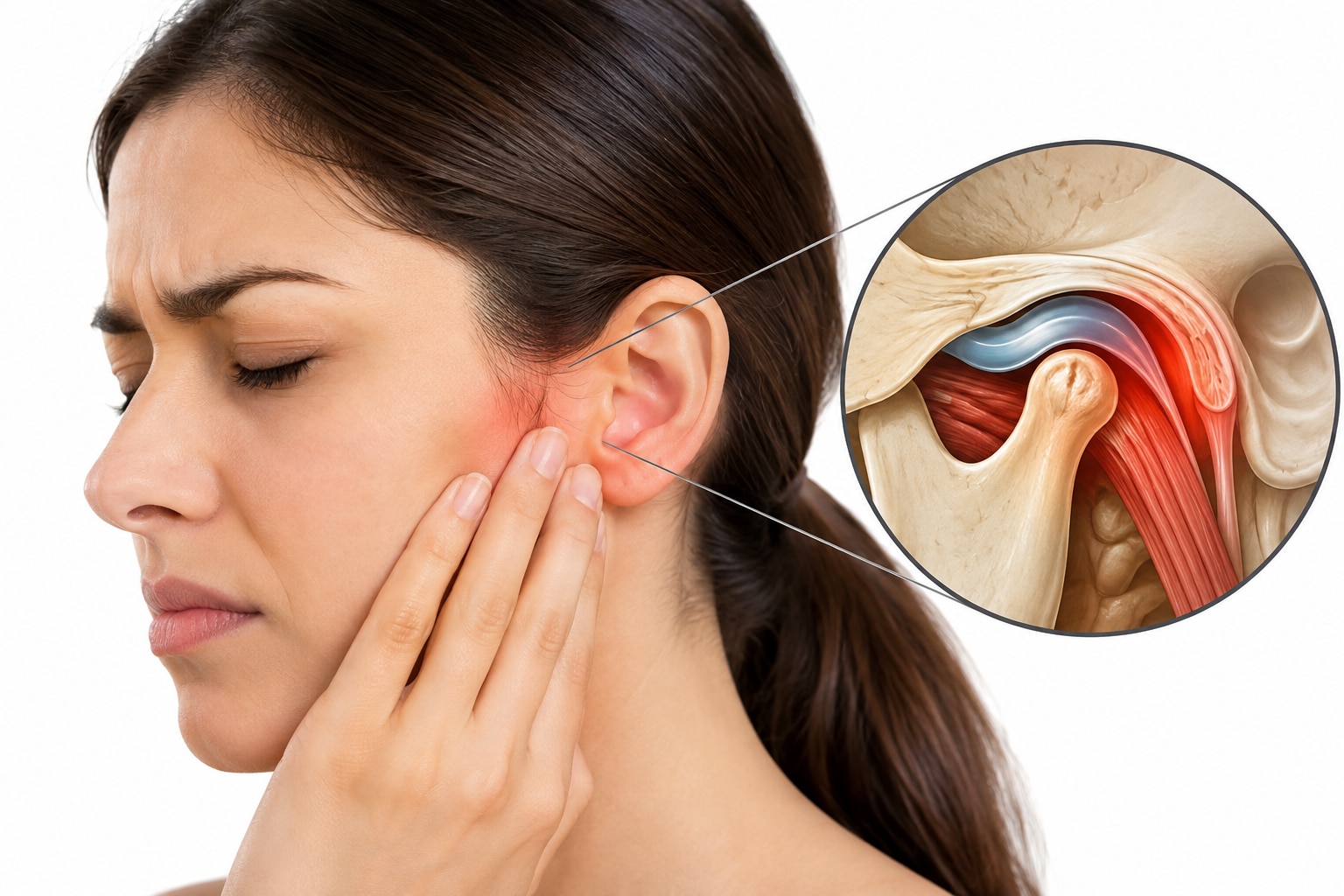
The temporomandibular joint sits in front of each ear, linking the lower jawbone to the skull and allowing you to open, close, speak, and chew. An articular disc cushions movement between the joint surfaces.
Pain can come from the joint, the disc, or the chewing muscles on each side of the face, so “TMJ pain” usually describes temporomandibular disorder rather than one single disease.
Everyday causes that overload these structures include:
- Clenching or grinding your teeth, especially during sleep
- Stress-related muscle tension
- Prolonged gum chewing
- Nail biting, pen chewing, or resting your chin on your hand
- A blow to the jaw or sudden wide opening
- Disc displacement, which can alter smooth joint movement
- Arthritis, including osteoarthritis or rheumatoid arthritis
- Uneven tooth contact that adds strain while you bite
| Source of pain | What is affected | Common pattern |
|---|---|---|
| Joint irritation | Joint surfaces or capsule | Pain in front of the ear, stiffness, painful clicking, or reduced opening |
| Disc displacement | Articular disc and its movement | Popping, jaw deviation while opening, catching, or locking |
| Muscle overuse | Chewing muscles | Tender cheeks or temples, pain while chewing, and temple headaches |
| Arthritis | Joint cartilage and bone | Stiffness, reduced opening, and painful grating or crepitus |
| Referred pain | Teeth, ear, sinuses, salivary glands, or neck | Jaw-area pain without a clear joint cause |
A click or pop without pain or restricted movement does not prove damage. One cause is not always identifiable; clenching, stress, injury, and joint changes can combine to produce symptoms.
How to recognise TMJ symptoms and separate them from other pain
Pain that increases with chewing, yawning, or opening wide points toward a jaw joint or chewing muscle, especially when you can reproduce it by pressing the temple or cheek muscles. TMD pain may spread to the face, neck, or temple and come with jaw stiffness, limited opening and locking jaw.
A changed bite, tenderness in front of the ear, or the jaw veering to one side while opening adds to the suspicion.
- Toothache usually centres on one tooth. Cold, heat, sweets, biting, or tapping that tooth can trigger it, and the pain may continue after the trigger stops.
- Ear pain often includes hearing loss, drainage, fever, or pain when the outer ear is touched. TMD can instead cause ear fullness or aching with normal ear examination.
- Sinus pain usually brings nasal congestion, discharge, reduced smell, or pressure across the cheeks and forehead. Bending forward can worsen it; jaw movement is less specific.
- A headache from TMD often sits at the temples and accompanies jaw muscle tenderness or clenching. Migraine may cause nausea, light sensitivity, or visual symptoms without jaw tenderness.
Clicking or popping without pain or restricted movement does not prove a disorder. Grinding, arthritis, or a disc problem becomes more concerning when sounds accompany pain, grating, swelling, bite changes, or difficulty opening or closing.
Arrange an examination if symptoms persist, recur, restrict eating or speaking, or you cannot identify a clear tooth, ear, or sinus cause.
What to do at home and when jaw pain needs a dentist
Start with reversible measures: choose soft foods for a few days, avoid gum chewing and extreme jaw opening, and use a warm compress for 15–20 minutes at a time. Keep your teeth slightly apart when resting, and follow gentle jaw-relaxation exercises from a dentist or physiotherapist rather than forcing a stiff joint.
Painful clicking versus painless clicking matters. Painless clicking without restricted movement is common and does not, by itself, prove a disorder. Clicking that hurts, grates, locks the jaw, or changes how your teeth meet deserves assessment.
- Routine appointment: Book a dental evaluation if pain persists beyond several days, keeps returning, or causes repeated headaches, facial tenderness, ear symptoms, tooth pain, or difficulty chewing or speaking.
- Prompt appointment: Arrange care soon for limited opening or closing, painful clicking, a bite change, progressive loss of movement, or a jaw that locks intermittently.
- Urgent care: Seek same-day medical or dental help if the jaw locks painfully, you cannot open it enough to eat or drink, marked swelling or fever develops, or a new jaw deviation follows an injury.
| Care level | What it means | When it applies |
|---|---|---|
| Routine | Book a standard dental visit | Persistent or recurring pain without major loss of function |
| Prompt | Arrange an assessment soon | Locking, painful clicking, bite change, or worsening movement |
| Urgent | Seek same-day care | Inability to eat or drink, severe swelling, fever, or injury-related change |
What a dental evaluation and imaging can reveal
A dental evaluation begins with your history: when pain started, what triggers it, whether the jaw locks, and whether your bite has changed. The dentist then checks the teeth and gums for decay, cracks, infection, or another source of referred pain before assessing the joint and chewing muscles. Clicking alone does not establish a disorder.
- Jaw range of motion, including how far you open and whether opening or closing is painful
- Jaw deviation, such as the lower jaw shifting to one side during opening
- Muscle tenderness over the temples, cheeks, and jaw, along with tenderness directly over the joint
- Joint sounds, locking, stiffness, and resistance during movement
- Tooth wear and bite, which can show clenching-related loading or a changed tooth relationship
Imaging is not automatic. A dentist chooses it when the examination suggests trauma, arthritis, a structural abnormality, persistent restricted movement, or another diagnosis that an examination cannot confirm.
| Test | Best information | When it adds value |
|---|---|---|
| Panoramic radiography | Broad view of both jaws, teeth, and the joint regions | Suspected dental disease, major bony changes, fractures, or an initial structural survey |
| CBCT | Detailed three-dimensional views of bone | Trauma, arthritis, abnormal bone shape, or persistent movement limitation |
| MRI | The articular disc, joint fluid, and other soft tissues | Locking, suspected disc displacement, or symptoms that persist despite an unrevealing bony study |
How TMJ treatment choices compare, including functional therapy
Start with the least invasive option that matches the diagnosis. Soft foods, avoiding gum and wide opening, heat or cold, jaw relaxation, and sleep or stress support require effort but carry little risk and suit many recent or mild cases.
| Option | Effort and risk | Best fit and limitation |
|---|---|---|
| Conservative care | Daily habit changes; low risk and reversible | First choice for many cases; progress can be gradual |
| Physiotherapy | Regular exercises and appointments; low risk when supervised | Muscle tightness, restricted movement, or poor jaw control; requires consistency |
| Prescribed medication | Short-term dosing; side effects and drug interactions matter | Significant pain or inflammation; use only as directed |
| Occlusal splint | Wearing and cleaning an appliance; a poor fit can worsen symptoms | Bruxism or tooth wear; it is not a universal TMD cure and needs dental review |
| Orthodontic treatment | Months or years; cost, cleaning demands, and permanent tooth movement | Correcting a separate bite problem, not routine treatment solely to cure TMD |
| Injections | Brief procedure; pain, bleeding, infection, or nerve injury are possible | Selected persistent muscle or joint problems after assessment |
| Surgery | Highest effort, recovery, and irreversible risk | Structural damage, locking, or severe disability after less invasive care fails |
| Snap Functional Therapy | Appliance use plus monitoring; suitability depends on the functional assessment | A non-surgical option for selected jaw-function problems, not a guaranteed cure |
Do not accept tooth reshaping, extensive crowns, orthodontics, or surgery as a first-line TMD remedy without a clear diagnosis and alternatives. At Sri Krishna Multispecialty Dental & Implant Studio, ask how the proposed treatment will be monitored and what happens if pain persists.
Related service
Pain (RCT) Save Your Natural Tooth with Comfortable, Painless Precision Endodontics Tooth pain, sensitivity to hot or cold, swelling, or deep decay are... View service → |
Frequently asked questions
What commonly causes TMJ pain?
Common causes include teeth clenching or grinding, jaw injury, arthritis, prolonged jaw strain, and problems affecting the joint or chewing muscles.
How can you recognise TMJ symptoms?
TMJ symptoms include pain in front of the ear, painful chewing, clicking or popping with pain, jaw stiffness, limited opening, locking, headaches, and changes in how the teeth meet.
What can you do at home for TMJ pain?
Choose soft foods, avoid gum and wide yawning, keep your teeth slightly apart when resting, and use a warm compress. Arrange dental care if pain persists, worsens, or causes locking or limited movement.
When should you see a dentist for jaw pain?
See a dentist for persistent or severe pain, jaw locking, difficulty opening or closing, swelling, an injury, a sudden bite change, or symptoms that interfere with eating or sleep.
What can a dental examination and imaging reveal?
An examination can assess jaw movement, tenderness, bite, muscle function, and tooth wear. Imaging can show bone changes, joint structure, displacement patterns, or other causes of jaw pain.