Tooth pain does not automatically mean you need a root canal, and pain disappearing does not prove that an infection is gone. You will learn which symptom patterns need prompt assessment, how dentists identify the damaged tissue, what treatment involves, and when another solution is more appropriate.
Key takeaways
- Lingering hot or cold pain, night pain, or spontaneous pain can indicate pulp inflammation.
- No pain does not rule out infection when the tooth pulp has died.
- Facial swelling, fever, or difficulty swallowing requires urgent dental assessment.
- Root canal treatment may fail when the tooth is cracked, unrestorable, or severely weakened.
Which Tooth Pain Patterns Point to the Pulp—and Which Do Not?
A root canal is not indicated by tooth pain alone. Pulp inflammation is more likely when cold or heat causes pain that lingers for 30 seconds or longer, pain starts without a trigger, wakes you at night, or becomes difficult to locate. A dead pulp can stop hurting, so absent pain does not exclude infection.
| Pattern | Clues | More consistent with |
|---|---|---|
| Brief, sharp pain from cold, sweets, or air | Stops immediately after the trigger ends | Dentin sensitivity from exposed root or enamel |
| Pain when biting or releasing the bite | Intermittent pain; a crack may be hard to see | Cracked tooth pain |
| Tender gum, bleeding, bad taste, or a loose tooth | Pain is local to the gum rather than temperature-driven | Gum disease |
| Pain when chewing after recent dental work | Filling or crown feels high; floss catches at its edge | Loose or poorly adjusted filling |
| Pain felt in one tooth but triggered by another | Testing identifies a different tooth as the source | Referred pain |
| Facial pressure, jaw-muscle soreness, headache, or several tender teeth | Symptoms change with sinus congestion, chewing, or clenching | Sinus or non-dental pain |
A dentist separates these causes with your history, cold or heat testing, tapping, bite testing, pulp vitality testing, gum measurements, and dental X-rays. Seek same-day care for facial swelling, fever, trouble swallowing or breathing, swelling near the eye, or inability to open your mouth.
How Dentists Identify the Exact Cause and Pulp Condition
A dentist does not diagnose pulp disease from pain alone. The history records what triggers the pain, how long it lasts, whether it starts without warning, whether it wakes you, and whether trauma or recent dental work preceded it.
The dentist also compares the suspected tooth with neighboring and opposite teeth, because referred pain or a high restoration can identify the wrong tooth.
| Condition | Typical test pattern | What else the dentist checks |
|---|---|---|
| Reversible pulpitis | Cold or sweet sensitivity stops within seconds after removal | Decay, exposed dentin, or a leaking filling |
| Irreversible pulpitis | Spontaneous pain, night pain, or thermal pain lingers after the stimulus ends | Cold and heat responses, bite pain, cracks, and restorability |
| Pulp necrosis | No meaningful cold or electrical response while nearby teeth respond normally | Percussion, palpation, radiographs, and infection signs |
| Dental abscess | Tenderness to biting or percussion, swelling, pus, or a draining gum lesion | Periodontal probing and X-rays for a root-end lesion or bone change |
Cold testing is common; electrical pulp testing supports it but does not prove healthy tissue. Percussion and palpation reveal inflammation around the root, while periodontal probing can expose a crack or gum-related pocket. Bite testing helps identify a cracked tooth or high filling.
A radiograph may show deep decay, widening around the root, or bone loss, but early disease can look normal. Dental abscess diagnosis therefore combines the history, examination, pulp tests, and imaging. Pain can disappear after pulp necrosis, yet infection can continue and spread.
When a Dental Infection Becomes an Urgent Medical Problem
Pain can stop when the pulp dies because the nerve and blood-vessel tissue inside the tooth no longer responds to stimulation. That relief is misleading: bacteria can continue multiplying inside the root canals and spread into the jaw, forming an abscess.
No pain does not rule out a serious infection or the need for root canal treatment.
| Sign | Required action | Why it matters |
|---|---|---|
| Facial swelling or fever | Same-day urgent dental assessment | Infection may be leaving the tooth and spreading through nearby tissues |
| Swelling around the eye | Same-day hospital-level assessment | The infection can involve deeper facial spaces |
| Inability to open the mouth normally | Same-day urgent assessment | Jaw-muscle and deep-space involvement can progress quickly |
| Difficulty swallowing | Hospital emergency assessment | Swelling can threaten the throat and airway |
| Difficulty breathing | Emergency hospital care now | An obstructed airway is life-threatening |
A dentist uses the symptom history, pulp testing, percussion, bite testing and dental X-rays to determine whether the pulp is dead and whether infection surrounds the root. Do not self-treat a dental abscess with leftover antibiotics.
When definitive dental treatment is available and there is no fever or spreading infection, antibiotics alone do not remove the source; spreading infection or systemic illness can require antibiotics alongside drainage or endodontic treatment.
What Happens During Root Canal Treatment?
Treatment usually follows four stages, although a difficult tooth can require more than one appointment.
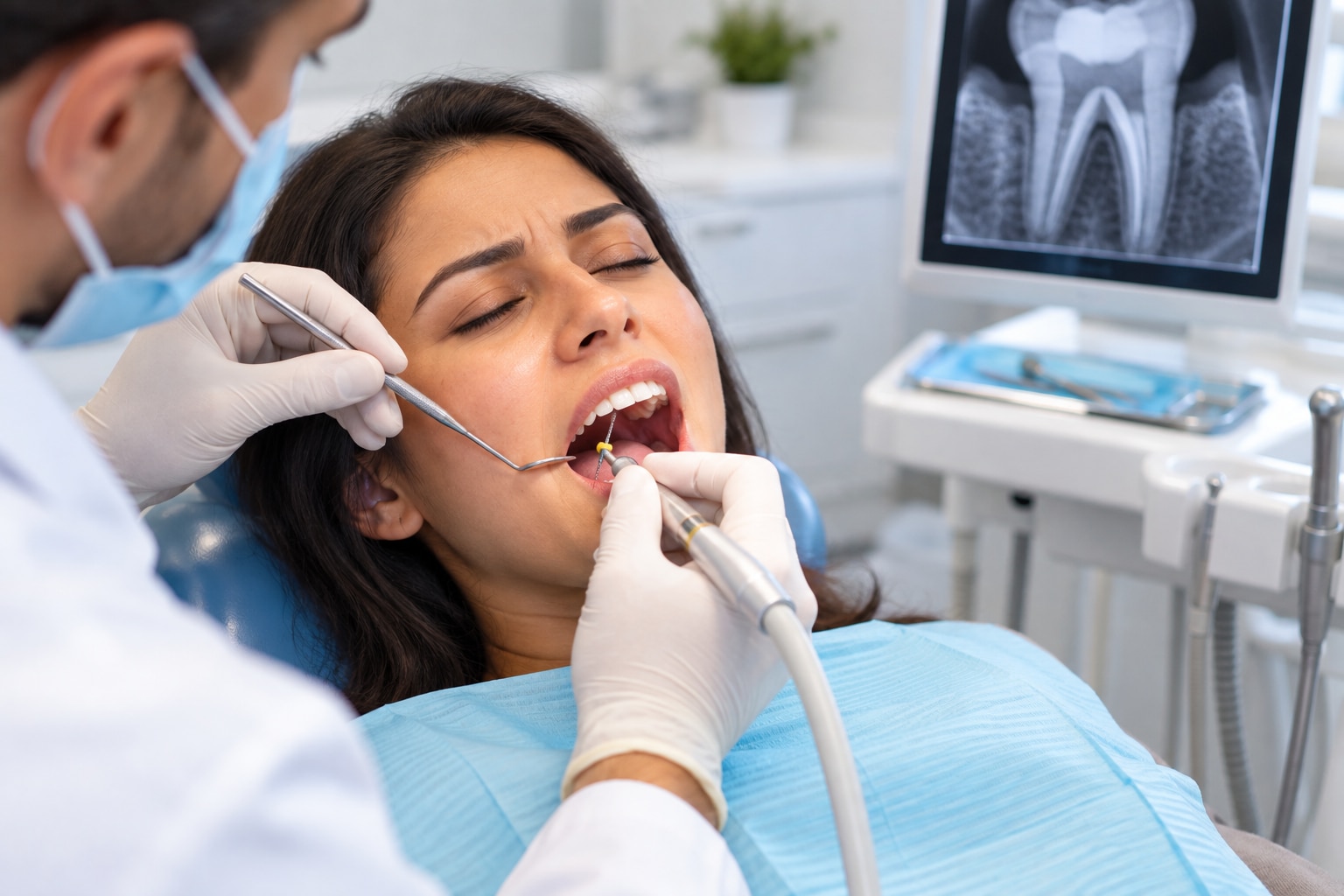
- Your dentist gives local anaesthetic, isolates the tooth with a rubber dam, and makes a small opening through the chewing surface.
- The dentist removes inflamed or dead pulp, locates each canal, and performs root canal cleaning and shaping with fine instruments and disinfecting solutions.
- The canals are dried, then closed through root canal filling and sealing to prevent bacteria from re-entering.
- The opening receives a temporary or permanent filling before the tooth is definitively restored.
Canal number and shape determine the work involved. A front tooth often has one relatively accessible canal; a molar commonly has three or four canals, with narrow, curved, or branching anatomy that takes longer to locate, measure, clean, and fill.
Calcified canals or blocked instruments can add visits because forcing an instrument risks perforating the root.
Molars also take heavier chewing forces, so removing pulp and cutting an access opening can leave less strong tooth structure. Your dentist may place a core and recommend a crown after the canal treatment; waiting with only a temporary filling increases fracture and leakage risk.
The final restoration affects appointment count because a permanent filling may be completed immediately, while a crown often requires preparation, an impression or digital scan, laboratory fabrication, and a later fitting appointment. The infection, drainage, anatomy, and restoration—not pain intensity alone—set the schedule.
When Root Canal Treatment Is Not Enough—or Not the Right Choice
Root canal therapy solves infection or inflammation inside the pulp and seals the cleaned canals. It cannot repair a vertical root fracture, replace lost periodontal support, or treat pain that originates in another tooth, the sinuses, or jaw muscles.
Pain after treatment needs reassessment, not automatic antibiotics or another root canal. Missed canals, leakage beneath a tooth restoration, recurrent decay, a new crack, or persistent infection around the root can cause symptoms months or years later. Root canal retreatment or root-end surgery may save the tooth; a vertical root fracture usually makes extraction necessary.
A tooth is worth saving only when it can support a durable restoration and has enough periodontal support and remaining structure. At Sri Krishna Multispecialty Dental & Implant Studio, that assessment should include the crack pattern, bone support, strategic value of the tooth, expected restoration, and your ability to maintain it.
| Option | What it involves | When it fits |
|---|---|---|
| Save with root canal | Clean, seal, and promptly restore the tooth | Restorable tooth with adequate support and no vertical fracture |
| Retreatment or root-end surgery | Address missed canals or disease at the root tip | Persistent disease when the tooth remains structurally sound |
| Extract and replace | Remove the tooth, then consider an implant, bridge, or removable prosthesis | Unrestorable tooth, vertical root fracture, or severe periodontal support loss |
Compare the whole plan, not just the procedure: treatment time, restoration needs, maintenance, cost, and the consequences of leaving a gap.
Related service
Pain (RCT) Save Your Natural Tooth with Comfortable, Painless Precision Endodontics Tooth pain, sensitivity to hot or cold, swelling, or deep decay are... View service → |
Frequently asked questions
Which tooth pain patterns point to the pulp?
Cold or heat pain that lingers for 30 seconds or longer, spontaneous pain, night pain, and poorly localised pain point toward pulp inflammation. A dead pulp can stop hurting while infection remains.
How do dentists identify the exact cause and pulp condition?
Dentists compare your symptoms with cold and electric pulp tests, tapping and biting tests, gum examination, dental X-rays, and inspection for decay, cracks, or a loose filling.
When does a dental infection become an urgent medical problem?
Seek urgent care for facial or neck swelling, fever, difficulty breathing or swallowing, confusion, or rapidly worsening symptoms. These signs can indicate infection spreading beyond the tooth.
What happens during root canal treatment?
The dentist numbs and isolates the tooth, removes inflamed or infected pulp, cleans and shapes the canals, seals them, and restores the tooth with a filling or crown when needed.
When is root canal treatment not enough or not the right choice?
Root canal treatment is unsuitable when a tooth cannot be restored, has a severe vertical root fracture, lacks adequate support, or has infection that requires additional treatment. Extraction can be the appropriate alternative.