Replacing missing teeth is not a choice between one universally superior denture and one inferior alternative. The suitable option depends on how many teeth are missing, the condition of the supporting tissues, the stability you need, and whether you can maintain the prosthesis reliably. By comparing each design’s support, comfort, cleaning demands and clinical requirements, you can prepare for a more useful discussion with your dentist.
Key takeaways
- Fixed options attach to prepared teeth or implants; removable dentures come out for cleaning.
- Choose partial, complete or overdentures according to the pattern of missing teeth.
- Compare stability, surgery, cleaning, chewing function and maintenance before deciding.
- Ask for an examination of teeth, gums, bone, bite, health and daily dexterity.
What makes a denture fixed or removable?
The fixed dentures definition is a replacement that stays attached to prepared natural teeth or dental implants. A tooth-supported bridge is fixed to prepared abutment teeth; an implant-supported denture can also remain attached to implants when it is a fixed full-arch prosthesis.
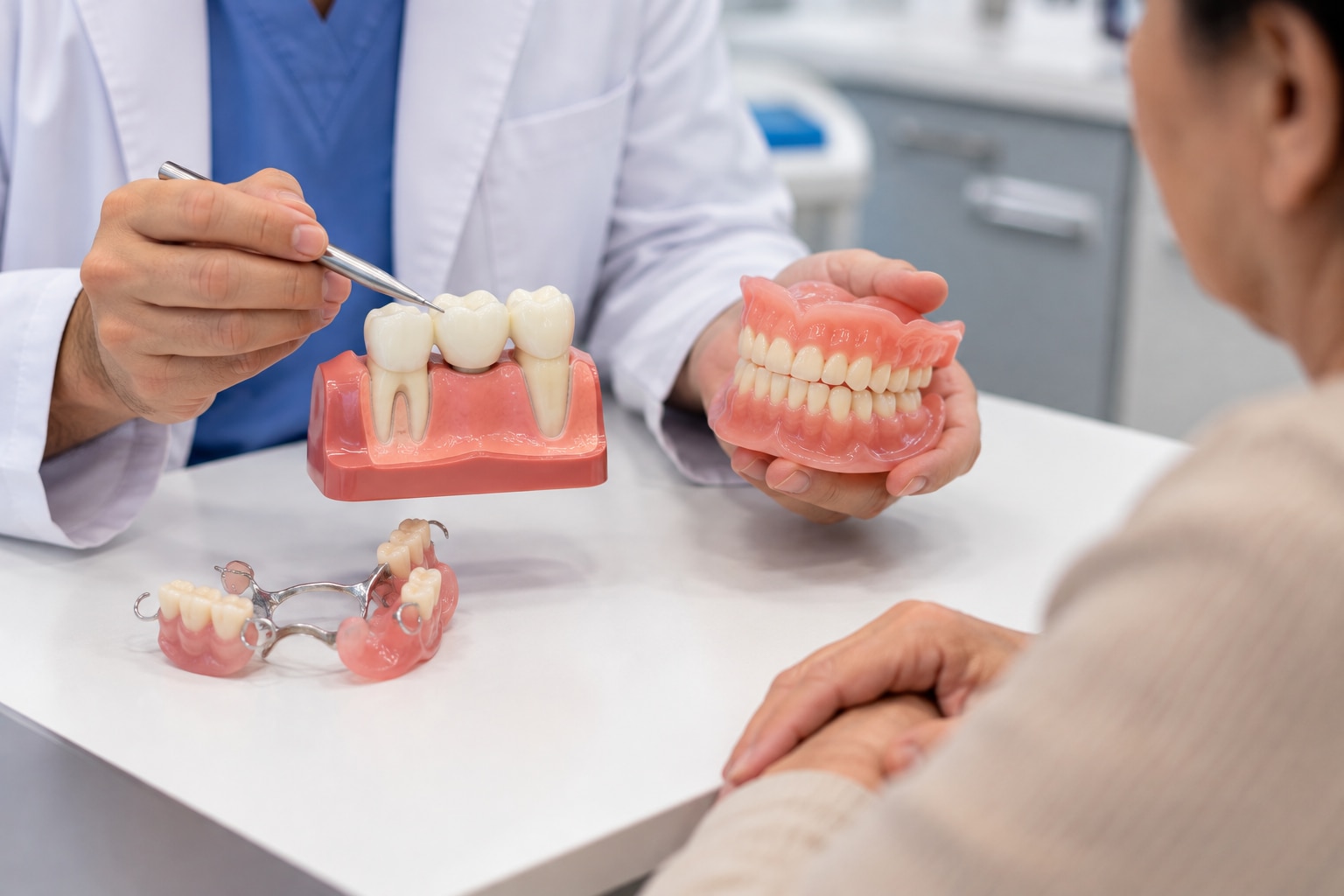
The removable dentures definition is a prosthesis that you take out for cleaning. It usually rests on your gums, the remaining teeth, or both. Acrylic partial dentures, cast-metal partial dentures, flexible partial dentures and complete dentures belong to this group.
| Option | What stays attached | Support and practical effect |
|---|---|---|
| Conventional removable denture | Nothing remains attached after removal | Rests on gums, soft tissue or teeth; retention and chewing stability depend on fit |
| Tooth-supported bridge | Bridge remains cemented to prepared teeth | Avoids daily removal but requires enamel removal and strong abutment teeth |
| Fixed implant prosthesis | Prosthesis remains attached to implants | Strong retention and chewing stability; cleaning underneath and servicing require extra effort |
| Implant-retained overdenture | Implants remain in place, but you remove the denture | More secure than a conventional denture while remaining easier to remove and clean |
“Fixed dentures” is not one standard category. The meaningful comparison covers support, retention, chewing stability, speech, appearance, comfort, cleaning and servicing. A lower complete denture can be less stable than an upper one because the lower ridge offers less supporting area and the tongue moves the denture.
Fixed is not automatically better: weak supporting teeth or inadequate implant bone support can make that design unreliable.
Which removable denture type matches the pattern of tooth loss?
The pattern of tooth loss usually narrows the choice: a few missing teeth may suit a partial denture, while loss of every usable tooth in one arch brings a complete denture into discussion.
| Option | Main design | When it may suit |
|---|---|---|
| Acrylic partial denture | A simpler, lower-cost base supporting replacement teeth | A transitional design, a short-term replacement or a case where a cast framework is not planned |
| Cast-metal partial denture | A stronger metal framework that rests on selected teeth and soft tissue | Several missing teeth remain, and those teeth can provide predictable support through rests and clasps |
| Flexible partial denture | A bendable, tooth-coloured base with different clasp and support behaviour | Appearance is a priority, but cleaning, repair and future adjustment must be discussed |
| Complete denture | Replaces every tooth in one arch and rests on the gums and residual ridge | No usable teeth remain, or the remaining teeth have decay, infection, advanced periodontal damage or too little structure |
| Immediate denture | Inserted soon after extraction | Appearance and basic function need protection during healing; adjustment, relining or replacement commonly follows |
A complete denture after extraction may be planned when saving the remaining teeth would not provide stable support. Healing changes gum and ridge contours, so do not judge the final fit from the first appointment.
Expect early soreness, increased saliva, speech changes and difficulty with firm or sticky foods. These are adaptation issues; a persistent sore spot needs adjustment, not prolonged wear. Remove the denture overnight, clean it outside your mouth, and clean your gums, tongue and remaining teeth daily.
How do bridges and implant-supported options compare with removable dentures?
A conventional bridge versus partial denture comparison starts with support. A bridge replaces adjacent missing teeth by joining a pontic to prepared abutment teeth. Preparation removes some enamel, and those teeth need adequate periodontal support and sound structure.
| Option | Support and retention | Practical trade-off |
|---|---|---|
| Conventional bridge | Prepared natural teeth hold the pontic in place | Fixed, but preparation can weaken unsuitable abutment teeth |
| Removable partial denture | Remaining teeth and soft tissue support the base; visible or concealed clasps provide retention | Replaces several teeth without implant surgery, but moves during use more than a fixed option |
| Implant-supported removable overdenture | Clips, bars or locator-style attachments connect the denture to implants | More secure than a conventional denture and removable for cleaning; attachments, liners and clips require servicing or replacement |
| Fixed implant-supported full-arch prosthesis | Implants retain the prosthesis continuously | Strong chewing stability, but cleaning beneath it needs floss threaders, interdental brushes or other devices |
A removable partial denture avoids implant surgery, but it depends on the condition of remaining teeth and soft tissue. A fixed implant-supported full-arch prosthesis requires surgery, healing and sufficient bone; bone grafting may be considered when available bone is inadequate.
Implant denture maintenance continues at home and in professional reviews. Food and plaque can collect beneath fixed implant work, and the prosthesis may need professional removal for inspection. Choose between these options based on tooth and gum support, bone volume, cleaning ability and willingness to maintain the result—not simply because one option is fixed.
Which option may suit your teeth, gums, health and daily abilities?
The number and position of missing teeth set the first denture suitability factors. One missing tooth between sound neighbours may suit a bridge; several missing teeth may suit a partial denture or bridge; complete tooth loss requires a full-arch decision. The strongest-looking option is not automatically the safest one.
| Option | Main trade-off | Often considered when |
|---|---|---|
| Bridge | Avoids daily removal but requires preparation of adjacent teeth | Neighbouring teeth are sound and well supported |
| Partial denture | Avoids implant surgery but uses a removable base, clasp design and extra cleaning | Several teeth are missing and suitable support teeth remain |
| Complete denture | Replaces every tooth in one arch but depends on gum and ridge support | All teeth in that arch are absent or have a poor prognosis |
| Two-implant overdenture | Remains removable but improves lower-denture retention | A completely edentulous lower jaw needs greater stability |
| Fixed full-arch prosthesis | Offers attached support but requires implants and demanding cleaning | Bone, health, hygiene and maintenance capacity support the plan |
Ask the dentist to assess gum health, neighbouring tooth prognosis, jawbone volume, bite forces, caries risk, gag sensitivity, hand dexterity and budget. A removable prosthesis is impractical if you cannot remove and clean it reliably. A fixed restoration is unsuitable when its teeth or implants lack periodontal or bone support.
- Smoking and implant treatment, because smoking can impair healing and worsen implant maintenance outcomes.
- Diabetes and dental implants, especially when diabetes is uncontrolled.
- Previous periodontal disease, which raises concern for future tooth and implant support.
- Dry mouth, which increases decay risk and can make removable dentures uncomfortable.
- Your willingness to attend adjustments, hygiene reviews and repairs.
What should the examination and maintenance plan include?
1. Start with a denture examination, not a preference for something fixed or removable. Your dentist should assess the remaining teeth, gums, bite, soft tissues and residual ridge shape, then use dental radiographs to check roots, bone and hidden infection.
2. Implant planning requires additional checks: bone volume, medical history, healing capacity, smoking status and diabetes control. The plan should also address caries risk, periodontal disease and your ability to clean around the restoration, because implants do not remove the risk of peri-implant mucositis or peri-implantitis.
3. Before fitting, ask how you will clean every surface and how often reviews are needed. Confirm what happens if a clasp, attachment, liner, bridge or implant component wears; clips, locator-style attachments and liners often need servicing or replacement.
Sri Krishna Multispecialty Dental & Implant Studio can connect prosthodontic treatment planning in Hyderabad with periodontal, restorative and implant assessment instead of choosing a design from appearance alone.
4. Build the denture cleaning routine into your daily schedule. Remove conventional dentures overnight unless your dentist gives a specific reason not to, clean them outside your mouth, and brush your gums, tongue and remaining teeth daily. Persistent sore spots need adjustment, not prolonged wear.
5. Adhesive can improve retention for a well-fitting denture but cannot reliably correct a loose or worn one. Fixed implant prostheses also require daily cleaning underneath and professional implant maintenance, because plaque control remains essential after fitting.
Related services
Crowns & Bridges Dental implants are the most advanced, reliable, and long-term solution for replacing missing teeth. View service → |
Crowns & Bridges Precision-Fit Restorations for Damaged or Missing Teeth – Designed Digitally for Function and Esthetics Crowns and bridges are fixed dental... View service → |
Frequently asked questions
What makes a denture fixed or removable?
A fixed replacement attaches to prepared natural teeth or dental implants and stays in place. A removable denture is designed for you to take out for cleaning and overnight rest.
Which removable denture type matches the pattern of tooth loss?
A removable partial denture replaces some missing teeth, while a complete denture replaces all teeth in one arch. An implant-supported overdenture is removable but gains retention from implants.
How do bridges and implant-supported options compare with removable dentures?
Bridges and fixed implant-supported prostheses provide a non-removable option, while removable dentures avoid some fixed attachment or implant surgery. Compare stability, tooth preparation, bone volume, cleaning and maintenance.
Which option may suit your teeth, gums, health and daily abilities?
The choice depends on remaining tooth strength, gum health, jawbone, bite, general health, tolerance for surgery and your ability to remove and clean the prosthesis.
What should the examination and maintenance plan include?
The plan should assess teeth, gums, bone, bite and oral hygiene, then set instructions for cleaning, reviews, repairs, relining and replacement as the mouth changes.
Related services
Crowns & Bridges Rebuilding Smiles, Restoring Confidence and Function – Digitally and Precisely Full-mouth rehabilitation is a comprehensive dental treatment that... View service → |
Pain (RCT) Save Your Natural Tooth with Comfortable, Painless Precision Endodontics Tooth pain, sensitivity to hot or cold, swelling, or deep decay are... View service → |
Cosmetic Dentistry Cosmetic Dentistry-Smile Designing Cosmetic Dentistry Creating Natural, Confident Smiles Through Art, Science & Digital Precision A confident smile can transform not just your... View service → |
Braces & Aligners Orthodontic Treatments Straighter Teeth, Healthier Bite, and Confident Smiles for All Ages Orthodontics is the specialty of aligning teeth and... View service → |